Implementing AI in your tax practice: why trust matters more than technology
Most AI implementations fail because firms skip the trust-building phase. A practical 4-phase framework for Belgian tax practices.
By Auryth Team
You bought the tool. You ran the demo. Everyone was impressed. Three months later, two people use it — and one of them is the partner who signed the contract.
This scenario plays out in professional services firms worldwide. BCG research on enterprise AI adoption found that successful implementation breaks down into three components: 10% algorithms, 20% technology infrastructure, and 70% organizational transformation. Yet most firms spend 90% of their implementation effort on the first two.
In Belgian tax practices, the gap is wider still. Tax professionals carry professional liability for their advice under the ITAA deontological code. When you ask them to trust an AI tool, you’re not asking them to learn new software — you’re asking them to stake their professional reputation on it. No wonder the demo alone doesn’t change behaviour.
The trust gap nobody talks about
The statistics are sobering. Research consistently shows that around 80% of enterprise AI projects fail to deliver on their intended goals. PwC Belgium’s own survey found that only 21% of Belgian companies have progressed beyond the AI pilot stage.
But here’s the counterintuitive part: Belgium ranks among the top three EU countries for enterprise AI adoption according to Eurostat. Belgian professionals aren’t technophobic — they’re discerning. They’ve tried ChatGPT for tax questions. They’ve seen it hallucinate article numbers. They know what bad AI looks like.
The problem isn’t resistance to technology. It’s resistance to unverified authority.
Tech-first vs trust-first: two approaches, one winner
Most implementation guides read like product manuals: install, configure, train, deploy. This is the tech-first approach, and it fails because it treats adoption as a software rollout rather than a behavioural shift.
| Tech-first approach | Trust-first approach | |
|---|---|---|
| Week 1 | Full team training, all features | One person, one use case |
| Month 1 | Everyone should be using it | Pilot user verifies 20 answers manually |
| Month 3 | ”Why isn’t anyone using it?” | Pilot user shares verified results with team |
| Month 6 | Subscription cancelled | Team builds shared query library |
| Result | Shelfware | Embedded workflow tool |
The trust-first approach is slower. It’s also the only one that works.
The 20-answer rule
Before anyone in your firm forms an opinion about an AI tool, one person should verify 20 answers manually. Not 5 — that’s too few to encounter edge cases. Not 50 — that’s too many to sustain motivation. Twenty.
Here’s what those 20 answers teach you:
- Answers 1–5: You learn what the tool is good at. Simple lookups, rate confirmations, article identification.
- Answers 6–12: You find the first limitations. A missing source, an outdated reference, a question it handles clumsily.
- Answers 13–20: You develop calibrated trust. You know when to rely on the output and when to double-check. This is expertise that no demo can provide.
Calibrated trust is more valuable than blind confidence.
The person who completes this process becomes your firm’s AI champion — not because they were appointed, but because they earned their own conviction.
A four-phase implementation framework
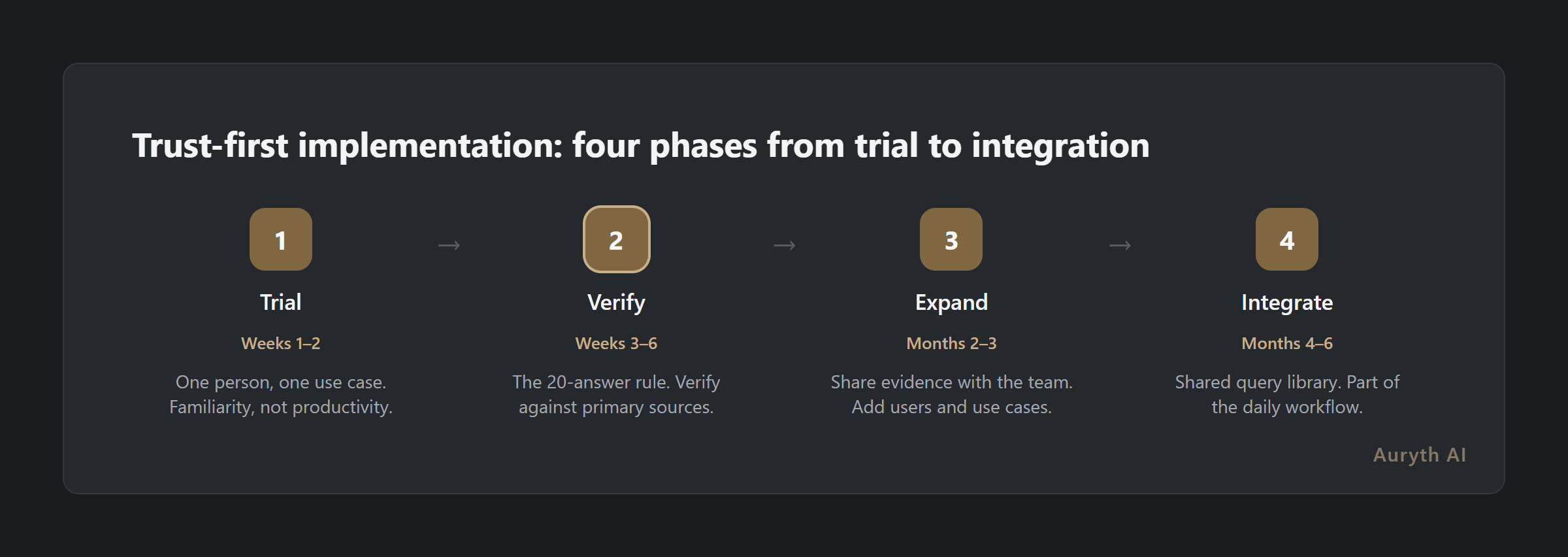
Phase 1: Trial (weeks 1–2). One person. One use case. Pick the professional who’s most curious, not most senior. Choose a narrow scope — TOB rate lookups, article identification, or ruling searches. The goal isn’t productivity yet. It’s familiarity.
Phase 2: Verify (weeks 3–6). The 20-answer rule. Your pilot user runs 20 real queries from actual client dossiers. For each answer, they verify against primary sources: Fisconetplus, Jura, the legal text itself. They document what was correct, what was incomplete, what was wrong. This verification log becomes your firm’s most valuable implementation asset.
Phase 3: Expand (months 2–3). Share evidence, not enthusiasm. The pilot user presents their verification log to the team — not “this tool is great” but “here are 20 questions I tested, here’s what it got right, here’s where it needed correction.” Colleagues trust peer evidence more than vendor demos. Broaden to 2–3 users and wider use cases: cross-domain questions, temporal queries, regional comparisons.
Phase 4: Integrate (months 4–6). Build institutional knowledge. Create a shared query library — templates for recurring research patterns. Document which question formats get the best results and which topics need extra verification. Make the tool part of the workflow, not a separate step.
Where it goes wrong: three implementation killers
The demo-to-deployment jump. Skipping from an impressive demo straight to firm-wide deployment. Without the trust-building phase, adoption collapses within weeks. This is the most common failure mode — and the most preventable.
Over-reliance without verification. The opposite failure: a user who trusts too quickly, stops verifying, and eventually produces advice based on an incorrect AI output. One bad experience poisons the well for the entire team.
Under-utilization from distrust. A user who was forced to adopt the tool, never trusted it, and uses it only for trivial lookups they could do faster manually. The ROI never materialises because the tool operates at 10% of its capability.
All three failures share a root cause: skipping Phase 2.
Measuring what actually matters
Forget feature adoption metrics. In a tax practice, three numbers tell you whether AI implementation is succeeding:
| Metric | What it measures | Healthy target (month 6) |
|---|---|---|
| Queries per professional per week | Actual usage depth | 8–15 queries |
| Complex query ratio | Trust maturity | >40% cross-domain or temporal |
| Self-reported time savings per dossier | Perceived value | 30–60 minutes |
If queries are high but complexity is low, your team is using AI as a search engine — not a research tool. If complexity is high but queries are low, trust is growing but the habit isn’t formed yet.
Common questions
How long does full AI implementation take in a tax practice?
Plan for 4–6 months from first login to embedded workflow. The first two weeks are exploration; the real adoption curve starts after the 20-answer verification phase. Firms that try to compress this into 2 weeks consistently report lower adoption rates.
Should we start with senior partners or junior staff?
Neither. Start with the most curious professional, regardless of seniority. Curiosity predicts adoption better than authority or technical skill. The champion’s role is to build evidence that convinces others — that requires genuine interest, not a mandate.
What if the tool gets something wrong during verification?
That’s the point. Finding errors during controlled verification is the best thing that can happen. It teaches calibrated trust and gives the pilot user specific knowledge about the tool’s boundaries. An error found during Phase 2 builds more trust than ten correct answers during a demo.
Related articles
- How to evaluate a legal AI tool: 10 questions that actually matter → /en/blog/juridische-ai-tool-evalueren-en/
- “I don’t trust AI for tax advice” — and you’re right → /en/blog/ai-weerstand-fiscaal-advies-en/
- How much time does tax AI actually save? An honest estimate → /en/blog/tijdsbesparing-fiscale-ai-en/
How Auryth TX applies this
Auryth TX is designed for trust-first adoption. Every answer shows its source citations — the specific articles, rulings, and commentary it retrieved. Confidence scores tell you how certain the system is, so you know when to verify further and when to trust the output.
The platform supports the 20-answer verification process naturally: each response includes the primary sources so you can check them against Fisconetplus or the legal text itself. Export features let you save your verification log and share it with colleagues.
Start with a 14-day free trial. Verify the first 20 answers yourself. Then decide.
Sources: 1. Yang, Y. et al. (2024). “Artificial Intelligence in Auditing: A Framework and Assessment.” Auditing: A Journal of Practice & Theory. 2. Daly, S. et al. (2025). “Trust and AI Adoption in Organizations.” Technological Forecasting and Social Change. 3. Ibrahim, M. et al. (2025). “Technology Acceptance Model for AI in Professional Services.” Information Systems Frontiers.